The Constellation Series CW OPO carries forward the lineage, spirit and performance of the old “Industry Standard” Aculight Argos OPO. However, it is a new carefully crafted and updated product which STILL beats the competition in performance specifications where it matters most for scientific applications and Spectroscopy: Power, Narrow Linewidth and single frequency operation.
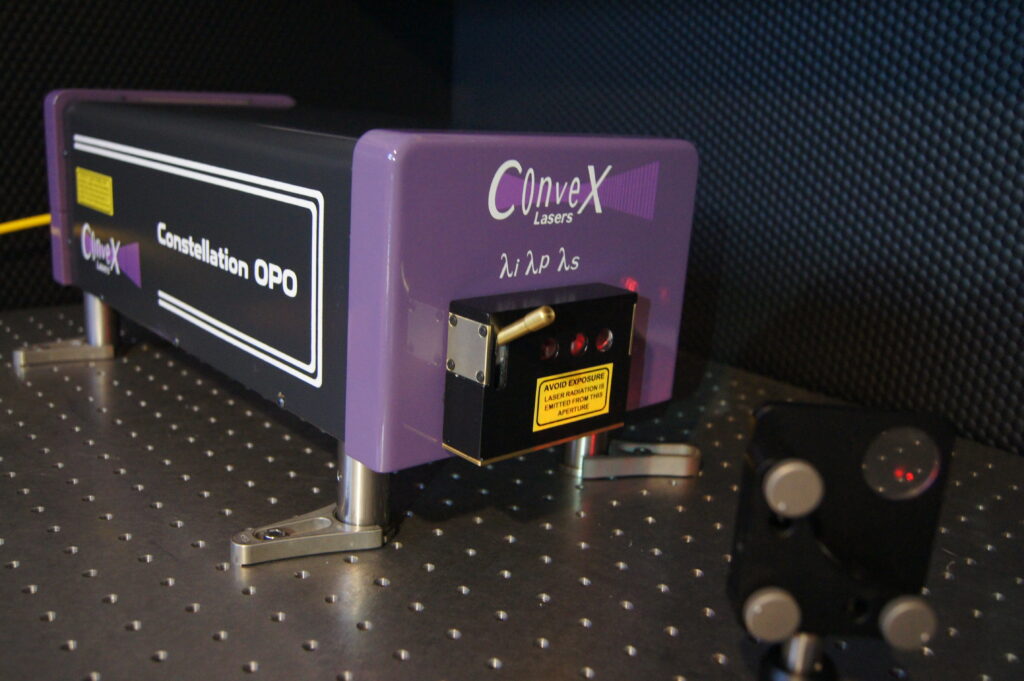
It has lots of improvements and added features based on customer feedback. It is a robust “Turn Key” system that is easy to use, requires no user alignment and offers 50 Ghz of Mode hop free tuning. It is also automated and allows customers to remotely control and program the tuning of the Etalon and PPLN crystal via stepper motor control for long “continuous tuning” across hundreds of nm of wavelengths. It also allows for much more simple and fast hands ON manual tuning via a physical controller box with momentary stepper buttons or by a computer GUI Application. It is air cooled and runs on standard wall voltage.
It covers Mid-IR wavelengths from 1460nm to 4600nm and boasts “typical” maximum CW Idler beam power levels of: >4 watts in the A module, >3 watts in the B module, >2 watts in the C module and >1 watt in the D module. Signal beam maximum powers are even higher as the modules progress farther out in the Mid-IR spectrum reaching as high as 5W of CW signal beam power.
The Constellation uses a “modular” approach where the Mid-IR spectrum is divided and covered using four individually available modules. This approach has multiple benefits over various competitors that offer far more expensive “all in one” solutions. This approach allows the design for each spectral region to be OPTIMIZED for the best performing optical coatings to yield more power AND allows for the use of the best performing Etalon materials for each specific module. The result is higher CW power for specific modules while still retaining those famous ultra narrow idler (and signal) linewidths of LESS than 1 Mhz. That is 10X narrower than competitor #1 (Idler) and 2X narrower than competitor #2 (Idler).
This “module specific” coating optimization also allows the Constellation (A module) and more specifically (D module) to have FAR more wavelength range to go with that added power. It is the only OPO with coverage all the way out to 4600nm! This “exclusive” performance is absolutely critical to customers researching key molecular targets in the 4.2-4.6um range such as Carbon Dioxide, Nitrous Oxide, Carbon Monoxide and more. (See Notes †)
Last, and most important for customers on a spending budget, this approach allows users a more affordable solution by purchasing only the coverage area they need, thus saving money over buying coverage for areas they don’t need. Even when purchasing a second module to extend coverage, the combined cost is still less than popular “all in one” OPOs.
The Constellation is available in both single frequency narrow linewidth versions AND various Broadband configurations with broadband units capable of delivering a staggering 10 watts of idler and an eye popping 20W of signal power! Both configurations are thus power and cost scalable depending on the pump level chosen. So you only pay for the wavelength region you need and the amount of power you need. This makes the Convex Lasers Constellation CW OPO the most affordable, flexible, powerful narrow line width tool available! There are other places you can spend the money you save.
Typical Performance:

SPECIFICATIONS:
| Wavelength Ranges | Module A | Module B | Module C | Module D |
| Signal range | 1850nm-1980nm | 1600nm-1850nm | 1460nm-1600nm | N/A (no signal) |
| Idler Range | 2200nm-2500nm | 2500nm-3200nm | 3200nm-3900nm | 3900nm-4600nm |
| Maximum Power: “Typical range peaks“ | Idler: 4 W @2300nm Signal: 4W @1980nm | Idler: 3.4W @2700nm Signal 4.5W @1756nm | Idler: 2.7W @3350nm Signal: 4.5W @1560nm | Idler: 2.5W @3950, 1.2W @ 4050nm, 400mW @4450 100mW 4500-4600nm |
| Minimum Power guaranteed at low point of range | >1W | >1W | >1W | >100mW 3900nm-4500nm >50mW 4500nm-4600nm |
| Linewidth | <1MHz | <1MHz | <1MHz | <1MHz |
| Beam Quality | TEM oo | TEM oo | TEM oo | TEM oo |
| Mode Hop Free Tuning Range | 50 GHz | 50 GHz | 50 GHz | 50 GHz |
| Cooling | Forced Air | Forced Air | Forced Air | Forced Air |
| Power | 110-240V AC 50-60Hz | 110-240V AC 50-60Hz | 110-240V AC 50-60Hz | 110-240V AC 50-60Hz |
(Notes †)
The Constellation D module exclusively allows for the study of the following:
Key Molecular Targets (4.2 µm – 4.6 µm)
• Carbon Dioxide ((CO_{2})): This region contains the extremely strong (\nu {3}) fundamental asymmetric stretch band centered around 4.2 – 4.3 µm. This band is several orders of magnitude stronger than the overtone bands found at shorter wavelengths, allowing for the detection of trace amounts of (CO{2}) with high sensitivity.
• Nitrous Oxide ((N_{2}O)): The fundamental absorption for (N_{2}O) is most intense in the 4.5 µm to 5.3 µm range. By reaching 4.6 µm, the Constellation can access the high-energy side of this fundamental band, which is vital for atmospheric monitoring and greenhouse gas studies.
• Carbon Monoxide ((CO)): The fundamental band of (CO) is centered near 4.6 µm. This is the “gold standard” for measuring (CO) concentrations in combustion research and environmental sensing because of the high line strength compared to its near-infrared harmonics.
• Deuterated Water ((HDO)): Various vibrational transitions for heavy water species occur in this region, making it useful for isotopic ratio analysis, which is a key tool in hydrology and planetary science.
• Other Trace Gases: This range also includes absorption features for Carbon Disulfide ((CS_{2})) and Carbonyl Sulfide ((OCS)), both of which are important in industrial process monitoring and atmospheric chemistry
Key Molecular Targets (3.9 µm – 4.2 µm)
•Nitrous Oxide ((N_{2}O)): This range includes the (\nu_1 + \nu_2) combination band and the high-energy side of the (\nu {3}) fundamental. The Constellation can hit multiple strong (N{2}O) transitions here, which are used for environmental monitoring and medical research.
•Sulfur Dioxide ((SO_{2})): The (\nu_1 + \nu_3) combination band for (SO_{2}) is located around 4.0 µm. Being able to hit these lines with high power and narrow linewidth is useful for detecting volcanic emissions or industrial flue gas.
•Carbon Disulfide ((CS)): Fundamental vibration-rotation bands for (CS) are centered near 3.9 µm. This is a major species of interest in astrochemistry and the study of carbon stars.
•Acetylene ((C_{2}H_{2})): The (\nu_4 + \nu_5) combination bands for acetylene are found in the 3.8 µm to 4.0 µm region. This is particularly relevant for industrial process control and ethylene production.
•Carbon Dioxide ((CO_{2})) Isotopologues: While the main (^{12}C^{16}O_2) band is further out, this region contains important lines for rarer isotopologues like (^{13}C^{16}O^{18}O) and (^{12}C^{16}O^{18}O). These are used in isotope ratio mass spectrometry (IRMS) alternatives.
•Heavy Water ((HDO) / (D_{2}O)): The (O-D) stretching vibrations for deuterated water fall within this window. This is critical for hydrological and climate studies that use hydrogen isotope ratios.Advantages of the Constellation in this RangeAccessing the “Gap”: Many systems designed for the mid-IR lose power or tuning stability in the 3.9 – 4.1 µm transition zone.
The Constellation’s module-based approach allows for high power specifically tuned to these sulfur and nitrogen oxide bands.Trace Detection: Because this is a low-absorption window for standard atmospheric (CO_{2}) and (H_{2}O), the Constellation can be used to detect trace gases (like (SO_{2}) or (CS)) with much higher sensitivity and longer path lengths without the background interference that plagues other regions.